
Authors: Chinchilejo Foundation EIN: 93-2687815
Date: July 25, 2025
Introduction
Kambo, also known as the “frog vaccine,” is an ancestral practice used by Indigenous peoples of the Amazon (Katukina, Yawanawá, Ashaninka) involving the application of skin secretions from the Phyllomedusa bicolor frog. Beyond its therapeutic dimension, this ceremony is a pillar of biocultural preservation aligned with the UN Sustainable Development Goals (SDGs).
CHEMICAL ANALYSIS OF KAMBO
The secretion of Phyllomedusa bicolor contains bioactive peptides with unique physiological effects:
| Component | Properties | Chemical Structure |
|---|---|---|
| Dermorphin | Analgesic 40x more potent than morphine; non-addictive. | Opioid peptide (Tyr-D-Ala-Phe-Gly-Tyr-Pro-Ser-NH₂) |
| Deltorphin | Modulates δ-opioid receptors; reduces inflammation and chronic pain. | H-Tyr-D-Met-Phe-His-Leu-Met-Asp-NH₂ |
| Phyllomedusin | Vasodilator; improves circulation and healing. | Bradykinin-related peptide |
| Bombesins | Regulates gastrointestinal function and stimulates enzyme production. | Gastrin-like peptides |
| Antimicrobials | Dermaseptins B2/B3; eliminates Gram+ bacteria and fungi. | Cationic α-helical peptides |
Source: Biochemical Pharmacology, 2023; Journal of Ethnopharmacology, 2022
HOW KAMBO GUARDIANS ENSURE ITS POTENCY
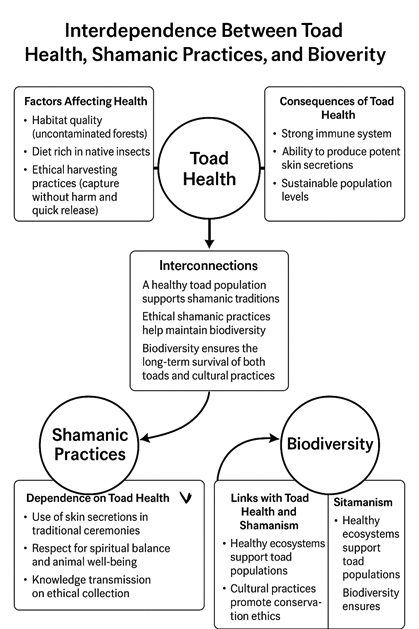
The “strength” of Kambo critically depends on ecosystem health:
- Ethical Sourcing:
- Frogs are captured harmlessly, gently stimulated to release secretions.
- Released within 24 hours in their native territory.
- Quality Indicators:
- Thick, glossy secretions: Indicate a diet rich in native insects.
- High dermorphin concentration: Correlates with unpolluted forests.
- Sustainable Practices:
- Rotation of harvesting areas to prevent population stress.
- Reforestation with medicinal plants that attract insects for frogs.
Diagram: Interdependence Between Frog Health, Shamanic Practices, and Biodiversity
PRESERVATION GOALS AND RECOMMENDATIONS
– CHINCHILEJO FOUNDATION –
- Biocultural Certification: Create a label certifying ethically sourced Kambo.
- Collaborative Research: Universities + Indigenous communities to study peptides and conservation.
- Responsible Healing Tourism: Community-led, with participant limits.
CULTURAL, MEDICAL, AND ENVIRONMENTAL BENEFITS
- Cultural:
- Transmission of knowledge: Shamans (pajés) preserve application rituals, songs (icaros), and origin myths tied to the “frog spirit.”
- Indigenous identity: Strengthens community cohesion and resists cultural erosion.
- Medical:
- Physical purification: Eliminates toxins (panema) through vomiting/sweating.
- Clinical effects:
- Boosts immunity (increases NK cells).
- Treats migraines, depression, and addictions (Frontiers in Neuroscience).
- Environmental:
- Ecosystem protection:
- Shamans (pajés) designate “sacred zones” for frog reproduction, banning logging/hunting.
- Monitor Phyllomedusa bicolor health to ensure potent secretions.
- Biodiversity: Habitat conservation benefits symbiotic species (insects, medicinal plants).
- Ecosystem protection:
ALIGNMENT WITH THE UN 2030 AGENDA
Kambo preservation directly impacts 4 SDGs:
| SDG | Kambo’s Contribution | EVIDENCE |
|---|---|---|
| SDG 3 (Health) | Access to traditional medicine for remote communities. Integration with health systems. | WHO: Traditional Medicine Strategy 2023–2030. |
| SDG 13 (Climate) | Conserved forests act as carbon sinks. | IIAP Peru: 1 protected hectare stores 200 t CO₂. |
| SDG 15 (Land) | Protection of Phyllomedusa bicolor and habitat. | IUCN: Frog is “Vulnerable” due to deforestation. |
| SDG 10 (Equality) | Economic empowerment of shamans via ethical trade. | RAISG: Communities manage 80% of bio-trade income. |
CONCLUSION
Kambo embodies the synergy between ancestral wisdom and modern sustainability. Its preservation not only safeguards invaluable medicinal practice but also activates ecological protection mechanisms aligned with the 2030 Agenda. As Yawanawá shaman Biraci states:
“Caring for the frog is caring for the forest; healing people is healing the Earth.”
BIBLIOGRAPHY
- Erspamer, V. (1993). Bioactive Peptides from Frog Skin. Annual Review of Pharmacology.
- UN Sustainable Development Goals (2023). Indigenous Knowledge in SDG Implementation.
- Lima, E.C. et al. (2024). Ecology and Chemistry of Phyllomedusa bicolor. Sinchi Institute.
- Chinchilejo Foundation (2025). Ethical Protocols for Kambo Harvesting.
“When the frog sings, the forest answers; when humans listen, the Earth heals.”
—Katukina Proverb